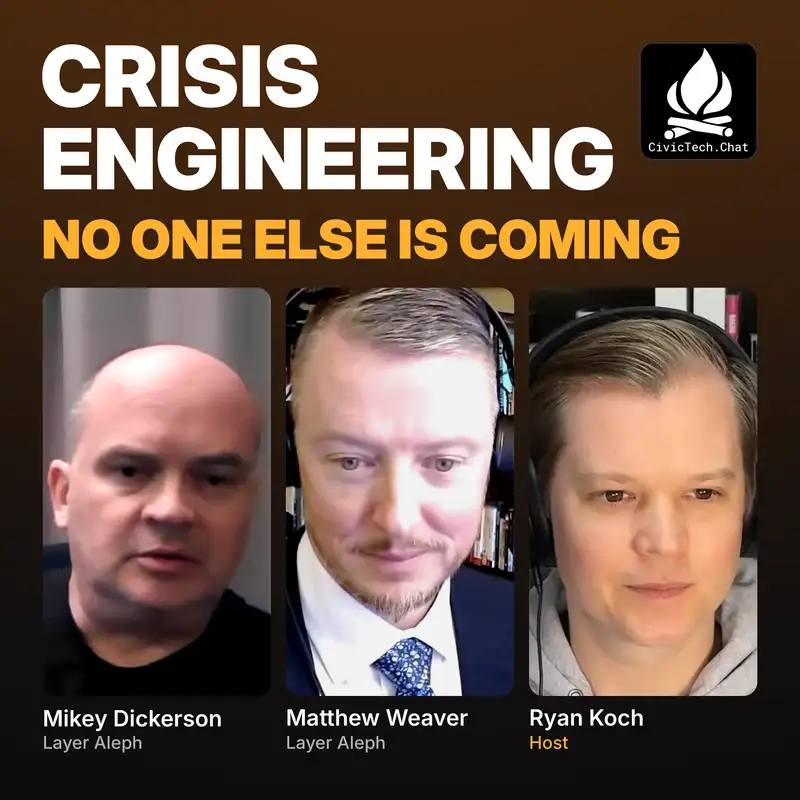
Crisis Engineering: No One Else is Coming
Ryan Koch (00:21)
Weaver, Mikey, thank you both for coming on to Civic Tech Chat. Could each of you introduce yourselves and tell us a bit about what you do?
weaver (layer aleph) (00:31)
Yeah, certainly. Thanks so much for having us, Ryan. We really appreciate being here today. my name is Matthew Weaver. Professionally I mostly go by Weaver. My background is in complex systems operation and troubleshooting. What I do these days is uh uh Mikey and I and two other partners have a small firm called Layer Olive. We specialize in crisis engineering. We help organizations seize crises as a moment for transformative change in any complex system at any scale. And we wrote a book about it.
Mikey.
Mikey (01:02)
I'm Mikey Dickerson. I don't have to tell you about Layer Aleph, because Weaver just did it. I used to work at Google and Site Reliability Engineering, and then I was the first administrator of the US digital service, as it was called, under President Obama.
Ryan Koch (01:16)
And for each of you, what is your personal why? That thing that drives you to get out of bed each morning and do all those things?
weaver (layer aleph) (01:24)
Um, yeah, of course. I like uh I'm I'm gonna use a baseball metaphor because it's on my mind right now. We're in a season where the World Series is happening here in the US and one of the teams is competing tightly uh in that race is called the Milwaukee Brewers. Uh and each of their players keep saying the same thing, which is uh every time they go out there on the field, they are just trying to do something for the team and trust the guy behind them in the lineup. You know, you know, and and and I think that's what a life is, uh as a person who
you know, is in a civilization and in a society and in a community that my job when I get up every day is to try to do something for that community, for that civil civilization and trust the next person. Uh so that's my why.
Mikey (02:07)
My reason why is maybe not as well thought out. It's something for me to do and keeps me off the streets and off drugs and whatnot. And uh of all the there's a lot of things wrong with the world, it looks like to me, and there's not a lot I can do something about, so the specific tiny slice that I can do something about, uh, is this slice. So here we are.
Ryan Koch (02:29)
And to add on an another why question, you know, we've re-hinted at that there's a book that we'll we'll end up talking about a little bit kind of into our conversation today. But you know, writing a book is a pretty difficult thing to do, very time consuming, and you know, you don't know how it's how it's gonna go until it's out there. So why take on that hard task? Why write a book?
weaver (layer aleph) (02:50)
Yeah. Uh it's a great question. And it is uh it's a lot of work. I'm I'm so grateful to my
co-authors. I can't imagine doing something like that alone. Uh it is it was like, at least for me, my experience was like having a permanently overdue homework assignment for like two years. This is I did not love it. Um though why so here's what happened. Um we as a firm were trying to figure out uh uh a few things. One of them was how to just explain what we did.
Um, and we talked ourselves into spending a little bit of time writing what we imagined to be some blog posts and talk content um as the first attempts to do that. And what we did is we sat down and we looked at uh all of the engagements we'd had as a firm and much of the work that we had done individually inside the federal government, inside of big companies. And we asked ourselves what
What was the difference between the engagements we'd had where things worked, where we were able to materially affect a complex system and the ones where we were not, the ones where we fumbled about and and sort of did not seem to make a percussive change. Um, and we just wrote down some of the things that that we found among um the the jobs where we did get something done, you know, what what what was the same about the circumstances in those cases and what was the same about our approach.
approach, you know, the actual techniques that we use. And so we did some writing around that stuff. Mikey along the way was doing a bunch of research into uh complex systems um and the, you know, scientific fields of complex systems management, sense making, anthropology, or organizational psychology, they used to call some of this stuff. Um, and then we got commitment escalated um by uh our co-author Marina, who couldn't be here today. Um
But as she had written a book before and she kept being like, Well, gosh, we could write a book, we could write a book. And we'd gotten some advice from some people we really trusted as we were taking this problem on the road to former clients and stuff. And we had a client tell us, Look, you're you're the best in the world at what you do, and there isn't a name for what you do. You should give it a name. Uh, and someone else told us, Well, the traditional way you do that is you write a book. And we were like, We definitely don't want to do that. But Maureen had written a book before and she kept kind of leaning on that. Uh, and then finally got us all to agree that she could at least send
Um, kind of like a pitch. There's a formal name for it in publishing, which I forget, but with the like an outline, kind of like a chapter list, um, a little description of a potential audience, to her agent and the publishing company that had worked with her on her first book, Balance Books, Hatch Hat. And we're like, Yeah, fine. I guess you can do that. and that worked. And they were like, Well, we'd love to do another book from you. Here's a contract. And then she kind of commitment escalated us into signing the contract, and then it was like, shoot.
Now we definitely have to write a book. So m Mikey.
Mikey (05:43)
That that's that that that's good. That covers it.
weaver (layer aleph) (05:47)
Yeah, it's a
different set of stuff than if you'd asked me like what's
nice about having done it. Um, from this side, it would be it would be beautiful to say, like, well, we really wanted to get down what we knew and and leave it for others to find and all that stuff. But like, I don't think that was on our mind at the front end. Um, but it is a little bit for me at the back end. Having written it down, it's it's it's continues to be an incredible and baffling experience for me to see pictures of like people I don't know with the book or uh hearing from people that I don't know who have read the book. Like that's really something.
And so from this side, I would say stuff like it feels good to have discovered that like we really did know a thing or two that was probably worth writing down um and and that we got it written down so that anyone who's up to this stuff we tend to do might come across and find it helpful. So that's pretty satisfying.
Ryan Koch (06:38)
Since you mentioned the feeling of seeing this thing that y'all made together just in different places. Is there anywhere surprising that you like saw somebody with the book or an unexpected person that kinda took you that, you know, had you taken aback?
Mikey (06:52)
Haven't
Haven't run into anybody in real life with the book yet, which would be fun. Uh I it might I I guess it would depend on circumstances whether I actually went up to them and said, Hey, that's a pretty good book you got there. So that hasn't happened quite yet. we have had random uh appearances on LinkedIn. A lot of people do some version of now. I know a lot of people do some version of here's the fixed books I read this quarter, or here's my summer reading list, or this or that thing. so it's always fun to turn up in those when
It's people that you know didn't get the book from us directly.
weaver (layer aleph) (07:28)
Yeah. One one there's probably two two experiences so far that have been surprising for me. Uh one of them is I got a photo from uh a friend and colleague, Deb Chatra recently, uh, of a university bookstore at the beginning of the school year, um, with the book on the shelf. and that for whatever reason, really, I was like, Whoa, yeah, right, because we didn't have any connection in that university. I didn't know anybody there. No one was like, Hey, can we like and there it was, you know.
That was really something. The other thing that was a surprise to me, this was not something I knew existed before it happened to us, but JP Morgan Chase, you know, one of the largest financial institutions in the world, uh, they do this thing where they have a summer reading list uh and they give a stack of books to all of their um wealth management clients. so these family offices, these people with huge piles of money who have JP Morgan help them invest and all this kind of thing.
And uh unbeknownst to us through some scheme that I don't know, our book was selected. Uh, and so JP Morgan not only gave our book to a bunch of these people, we got this funny little plaque that that's like signed on the back by Jamie Diamond. It's like, hey, thanks for your book. You know, good, yeah, good job.
Ryan Koch (08:40)
really? Wow.
weaver (layer aleph) (08:42)
Like we think your book's good and we gave it to a bunch of people. I was like, What? What in the world?
Mikey (08:48)
I I didn't even notice that until we were just at it, but sure enough, there there it is.
Ryan Koch (08:53)
Wow. Wow. I for folks that are listening audio only, he was showing the the signature on the on the plaque for folks that are on on the video version of this. Um wow that that
that's like a wild way to see like the ripples of something you make kinda heading out into the world. Um and before we go too deep into the book itself, in our prep conversation, it was mentioned that there's this thing called tech viaduct that uh y'all have been involved with. what is that and why are you keen on working on it?
weaver (layer aleph) (09:24)
Yeah, Mikey, tell us all about that.
Mikey (09:26)
uh that's a project that Marina, who's the third author of the book, who's doesn't happen to be here today, and I are part of. Um
What that comes down to is uh all of us worked in the federal government. All of us, I mentioned earlier, uh worked in what we called US digital service at the time. Uh close observers will recall that with the beginning of the second Trump administration, it got turned into US Doge service and put to rather different purposes than we meant for it to do. And so uh uh a lot of us who have a history uh with that, you know, with the government reform and civic tech type work.
uh are kind of uh excited for the chance to try to uh rebuild things better than they were before uh if they have been torn down over the last three or four years. And really we really wanted to make the point that it would be a mistake for the whatever administration comes after Donald Trump to think that the right thing to do is uh undo all of the last four years and put everything back exactly the way it was, exactly the way it was, was not great, and is how we got into this situation that
we're in now. So that was a kind of a controversial thing to be saying in the beginning of 2025 is like actually some of this destruction was necessary. Um and it's much less controversial now just the you know the political winds have changed. But that's the purpose of that project. Uh besides Marina and I, there's a core team of about six people and then there's about a hundred other kind of loose contributors. Uh and they're trying to set up plans for what a what an what what a future administration uh uh
could look like that wants to uh maintain some of the urgency uh and s and remove some of the you know ossification of the of the government as we knew it, but put that energy to use to make it able to do useful things for people. So that's kind of the the that's kind of today's purpose statement for tech viaduct according to me anyway.
Ryan Koch (11:27)
I think related to that, y'all had also mentioned, related to your practice, that you had thoughts for a sort of industry group kind of thing. Uh w what what what was that concept for folks listening?
weaver (layer aleph) (11:41)
Yeah, yeah, I'll I'll take a shot at that. Yeah, we we
have been doing a little work with some like minded uh small organizations around an alliance called the Viable Systems Alliance. Um you know, uh adjacent to our own ideas uh about organizational change, um, many of which are in the book, we we think that um
Actual transformative change in the management of complex systems, which is a term of art. It it merely means a system with machine components and people components, which by the way, these days is basically all of them because software ate the world. Um that uh effective change in the management of complex systems is always the outcome of a relatively small empowered group of people.
Like that is always how that happens. there there are sort of big slow organizational changes that can be managed over years to make incremental changes to the way things work. But any kind of percussive and transformative change that's visible like from hu human lifetime timescales, uh always, always, always is the result of the work of interdisciplinary teams that are relatively small.
Um, and so we have been, we think there are some of these lying around, uh, you know, so to speak, that are doing that sort of work uh for all the organizations in the world. And we are doing our best to kind of be in touch uh and start to talk about this out loud together and be in a position to make each of these smaller teams more visible and available to the larger organizations which they can help.
Ryan Koch (13:29)
Mikey, the the book mentions a story where you agreed to do a small favor for a friend back in October of twenty thirteen. And that ends up turning into a conference call where you're with uh US CTO Todd Park and he asked for a handful of technologies to to help out. And suddenly then you're in a situation where you have three days to figure out whether healthcare.gov could be saved.
What did you see in those seventy two hours that made you think that it could?
Mikey (14:00)
Since it's been twelve years and I don't have to have every word edited by multiple communications offices these days, uh I can give a shorter answer than I have in the past. The reason we thought after the first few days that there was that we could probably put this back together is because so many of the problems were so stupid and basic. Uh there were like large parts of the website that just were not configured with the right server names for other large parts of the website, stuff like that.
so like that let us for a time, you know, there was there was a lot of low-hanging fruit. So in the first week or two there were a lot of opportunities
to uh be amazing technological wizards who could uh solve the you know the deep subtleties of the dark arts of fixing typos and in config files and stuff like that. So that that we extrapolated from that and said uh I think if we spent a few
Of course we didn't this was not the way we phrased at the time 'cause we didn't expect this was very stupid in hindsight, but we didn't expect that the minute we said it could be fixed the next request was gonna be, Okay, why don't you all stay here forever and fix it? Uh so we didn't we didn't we didn't see that coming as obvious as it was and said, Yeah, like snow somebody who knew what they were doing, I think if they spent a few weeks working on this this could be working okay by the end of the year. Um
'Cause because there was so much, you know, really easy stuff.
Ryan Koch (15:30)
And when you got to the you know, to the end of day three, what did you wind up telling Todd Parker?
Mikey (15:37)
I mean I guess I spoiled the ending. We at the end of the day three we said yes. I think if a f some people who knew what they were doing, uh spent a few weeks fixing the integration problems. Uh
I mean I'm calling them I'm calling them dumb easy problems 'cause they aren't hard to fix but they're also it's also normal for something like this to come you know it's gonna be like that when this is all done. If anybody's ever had a house renovated, uh or put a car back together or something like that, like you're gonna forget a screw and end up having to take the whole thing apart and you know th th these are normal things to happen, but there's a lot that were not hard to fix. So that's what we told. That's what we told Todd. Uh we didn't know that there
we didn't have a clear understanding that what they wanted that information for was because they were choosing uh ah they were choosing between stories that they were gonna have to um
run with from the White House where choice one was uh okay, we're gonna take a year pause because this wasn't ready on time. Uh so maybe next open enrollment season, which would have been 2014, I guess. maybe then we'll be ready for all of the benefits we've been promising for the Affordable Care Act, which would have been not great. They're both not great options politically, but this is the less great of the two not great options. and then the second option
was uh hang in there, we're still gonna do it this year, open enrollment period is gonna happen. It, you know, we'll extend the deadline if we need to, but the whole website is gonna work by and then fill in a date there. That's what they wanted to get out of us was what date could go in that sentence, uh if if at all in 2013.
Ryan Koch (17:19)
And Weaver, you joined the healthcare.gov effort january twenty fourteen, when the crisis team had grown to around a a dozen people. What did it look like as things moved from emergency towards more like systems and structure?
weaver (layer aleph) (17:35)
Yeah. Um, yeah, I joined during a different season. You know, right, a little uh different piece of time. Um, what what things looked like when I showed up is that um Mikey and and some of these other folks over there from the, you know, Octoberish time frame had mostly gotten a website that worked. Uh it was fragile, you know, things would break on it every day. Um, its capacity was a constant source of
problems, right? There was still the it's just fundamentally the demand outstripped uh what the site could do in a day. And so what it looked like is Mikey and some of the others had made it so that they could start to rotate staff in because there was still this job that was sort of uh in shifts to stand in the middle of that outrageous circus. Um and
Manage what was happening, bracket and frame the story for the given day about what we were investigating, what action we would take, get right, and then observing those results and repeating that with the goal of A, keeping the website on, and B making sure that tomorrow it would have at least as much capacity as it had today, and perhaps more if we could do that. Um, and so uh I I'm I mean, if you'd asked anyone in that room.
whether they had returned to normal mode of operation and had exited a crisis, absolutely no one would have said yes to that. To be like, no no, we're obviously still in a crisis. But from here, looking back, um, what I would say is that we are still using the tools of crisis eng engineering, the tools that are effective when you have an organization that has willingness, because it is in a crisis, uh, to manage an ongoing workflow, right?
Um, and my job in particular was to we I've we called it the pit boss, but it was basically to be the person who was in the middle of that thing on the phone bridge in this room with a hundred people in it, who just would like manage the flow of facts and shepherd that decision-making process and then chase down people and make sure they took the actions that we all agreed would be taken to to manage what was going on and kind of repeat that over and over and over again, right? Um
So yeah, I would say we were using the tools of crisis to manage daily workflow, which by the way, that organization kept up for years. Uh, the room that got stood up to do all that work, the so-called XOC, the integrated operations center, the physic the physical room as the center of operations was not decommissioned until a decade later.
Ryan Koch (20:15)
Often in these sorts of situations, what folks might view as like the boring stuff and I'm doing like air quotes, um, are often like the most important kinds of things. So in that in that period, in that story you're you're telling, what was the boring thing that m ended up mattering the most?
weaver (layer aleph) (20:33)
yeah, there's probably a lot of them. Um, a thing that I'll talk about just because this is such an essential tool for these sorts of situations was uh I forget what we actually called it, but the boring, most important piece of what was going on in that whole thing, there were two. One of them was an always-on phone bridge from a polycom conference phone.
Some of your listeners may have seen these things in their real lives as like a tripod kind of thing with a big round speaker in the middle, you know, and it sits in the middle of the table and has like a big red light on it. Like the one of those. Yes, Mikey is showing you.
Ryan Koch (21:08)
yes.
weaver (layer aleph) (21:08)
Uh, for those of that are just listening, Mikey is demonstrating a model of the polycom phone. I also have one laying around here somewhere for reasons. Um, so so that um and what was going on is the whole room, of course, was on that because it's a speakerphone. You can't ignore.
ignore it. And then contractors and operators from all these other organizations and systems that were part of this thing were dialed into it. And so this is where you would so that is a very boring piece of technology that was absolutely essential. Uh the other was a Google Doc. so just like an online shareable editable document that we could send the link to anybody that was a reverse chronological, you know, we would add to the top of it list.
of what was happening, a log of like here is what was observed, here is what happened, here is the decision we made, here is the action we're going to take, here is the result of that action, just minute by minute, hour by hour, day by day, um, adding to the top of that. And like those two things, those very boring things, were easily the most important machine components of what was happening.
Mikey (22:20)
That's and even more dumb and boring.
Danat was the in the first 24 hours that any of uh the group that I worked with was on the scene was we told the agency that what this this what they were doing was not working and they needed to have all of those representatives of the dozens of different companies that were involved go to the same place uh and just stand around in the same room so that we could have a meeting with them that uh didn't proceed at the pace of a zoo.
Meeting with 60 people that are also doing something else at the same time on it, which is what happens when you try to do that with a Zoom meeting. which is the thing we get possibly the most uh questions or pushback about when we talk about the book is everybody wants all of this to work without having to get off of their couch or leave their house and go to the place where the work is happening. people really, really want that to be an option, and we tell them every time that it's
It's not. It just does not work very well. Um, and if they insist, then we say, Look, I mean, yes, if you're asking me, can you run a marathon with
a 20-pound sandbag tied to each ankle? Like, uh okay, you can do that. Uh, you may be able to finish it, but like you're going to be you're at least a lot slower uh than you would have been if you would have uh taken the sandbags off your ankles. And usually you're talking to us because.
because your organization has already exceeded the capacity or velocity of what it's able to do. So now you're asking me whether you can catch up uh with this major, you know, having having having uh having handicapped yourself before you start. So like I it's not it's not not our advice.
Ryan Koch (24:13)
And the the book uses the term crisis engineering in the title. Very first word of that is crisis. So for this conversation, let's take a little time to define that. What is a crisis?
weaver (layer aleph) (24:26)
Be honored. Uh lots of organizations and individuals believe they were in a crisis. We don't think that's true most of the time. Um, the word is Greek. Uh English stole it from there. Uh, and in Greek, crisis very specifically meant uh the point in time of an illness where either it would break or kill the patient. So, like, would the fever break or not? Uh and um
We suggest there are sort of five criteria to look for. and if you have somewhere between three and five of these, uh you are in crisis, which is to say the that you are at the place, you or the organization are at a place where either something uh transformative will change or you will fail to proceed through the crisis. You know, a crisis requires transformation for procession. You that change is required to proceed, right?
so one of those indicators is fundamental surprise. Uh this we borrow from the military. Military intelligence is the source of this phrase originally. it's used all over the place now. Um, it simply means something has occurred that was completely outside of an organization's ability to even imagine occurring. Um, we jokingly use an example of like uh, you know, your your pet cat invites you to come up with them to their spaceship.
Yeah, right, just to like completely uh Ian Banks, the celebrated science fiction author, called it an outside context problem. Um, to pick on healthcare.gov some more. An example is you are the second largest federal agency in the United States of America, HHS, and Congress directs you to build a website, uh, which is something you have never done before, right? two, a failure of sense making. Um, so what this looks like is information gathering.
has broken down inside the organization. The way you can observe it is that leadership or any room of people that you assemble all have a different story about what is happening, what is going on in the environment and circumstances around them. Um three is a disruption of core process and outcome. Uh so the the main thing that your organization does is either not happening or is falling behind faster every day.
You know, so you're you're ticket master and you can't sell Taylor Swift tickets because you're offline, right? you're Maersk, responsible for shipping everything around the world, um, and you have closed or rerouted your Middle Eastern shipping lines to run around the Cape of Good Hope. You've increased the length of the trip by an order of magnitude. Uh you're an air carrier and all your planes have been grounded, right? It's the easiest to recognize uh and see.
For high visibility, either internally or externally. You y you know, you and your organization and its failures are are are on the news every day. You are in the cycle of One America News or Fox. You are in the cycle on CNN. Like you're you're you're the thing that everyone is paying attention to. Or um internally, meaning uh everyone in the company is paying attention to the same thing, a leadership scandal. Yeah, right. Take your pick, something where out like all attention is on a small number of things in
Internally. Often the external visibility is the side effect of like a regulatory intervention or something, right? Like your executive is testifying or you're, you're, you're down, this kind of thing. And then lastly, um, uh a rigid deadline or time frame. Uh, and when we we we really mean rigid here. So things like a product launch that's supposed to happen by a certain date that can just simply be changed, those don't count. we'll often point out that even tax day.
Can move the IRS. Sometimes they'll be like, just kidding. Like, uh, so we think of things more like uh market open is a great example. Like market open is not gonna move for your bank because you couldn't get your act together overnight. Um, launch windows in aerospace applications are another great example. They're dictated by physics. Like no matter how much we care or want some other outcome, we can't change them. Uh or
deadlines that are imposed by a higher order control system. So courts or regulators, uh, or even investors, right? Think of uh um closing around of investment or a merger. The often there are higher order control systems that impose deadlines that cannot be negotiated. Uh and so anyway, we think if you have again two, three to five of those, you are probably in a situation where the the tools of crisis engineering can actually be used to help with that.
uh transformation that's required to proceed out of the crisis.
Mikey (29:06)
If I could if I could give you a um since it is October when we're recording this, I can't resist a little bit extra on Weaver's point about fundamental surprise. Uh and has has as it applies to an organization, usually means the organization is being able to do s ask to do something it has never done before. so there's this movie The Nightmare Before Christmas that we watched a little while ago. Uh and if you're if you're whoever's listening to this hasn't watched it recently should put it on because it turns
Out is a tale of enterprise transformation, uh, where the if you have forgotten the plot, the the main character Jack uh runs the organization that produces Halloween uh in some kind of poorly defined animated way. Uh and uh finds out about Christmas and wants to switch to producing Christmas uh and gives the top-down direction that this is this company produces Christmas now, but they're not ready for that. It is not anything like the culture that they have built, and therefore the enterprise transformation is not.
Very successful. They did not have the correct uh crisis
conditions. Uh, it was not necessary to uh they there was nothing there was no deadline, there was none of that stuff that Weaver was describing, so it goes awry. Uh and I am sure that that that that lesson is what Tim Burton had in mind when he wrote that screenplay.
Ryan Koch (30:26)
Mikey, I wanna see
your like the blog post for me that's like the postmorem the nightmare before Christmas. I I think the audience wishes for it.
Mikey (30:31)
Yeah, we we we started
it once and we I think we did finish it. We keep not making the Halloween deadline and then being like, well no one wants to what read it now. It's November, so
Ryan Koch (30:41)
Um what what I hear being described a bit is that these are things that are like pretty strategic problems, like even potentially threatening like the core existence, like reason detra for an organization. I imagine that folks out there can find themselves in a seat where something feels like it might be that, but they're wondering to themselves if it really is. So that begs the question, like how can listeners tell a a real crisis from a phony one?
For lack of a another way to put it.
weaver (layer aleph) (31:13)
Yeah, uh it's a great question and a common set of circumstances as I hinted at earlier. I'll I'll say two things. One of them is this stuff is scale independent. Um, so and what I mean by that is, you know, the whole organization can be in a place where these things are true. And in fact, I would say like a whole country, a whole planet. but that scale independence goes the other way as well. A whole division, a whole team, an individual.
Can all have these things be true. My my practical advice, uh, and we find ourselves giving this a lot because we get this question, particularly from um the sort of personality that frankly many of us in the firm share, uh, which is we have spent some season of our lives being the person in an organization who's going around being like, obviously there's a crisis. Why doesn't everybody care about the things that I care about? You know, why isn't everybody seeing the thing that I can see? Um, is to take a careful inventory.
uh using our list of five things, really look around you and get honest with yourself answering these. Um, and you will discover that probably only one or maybe two of them are true. Uh and my advice is it y you you're unlikely to change those circumstances. That is not often the situation that exists for a person is to change the deadlines in a way that can stick to to write.
you you cannot sort of precipitate a crisis. You sometimes can do things about visibility, but it's a very risky move to, you know, you know, say go to a journalist or something. Like maybe that gets you what you want, but more likely it just you're you're putting landmines right in front of yourself. Right. Um and and so it it advice I have on a personal level to anybody who finds themselves in that situation where they've taken the inventory and discovered that like the organization is not in crisis is the organization is not going to change.
It is not going to wake up tomorrow and care about the things that you care about. And so your actual practical choices here are to change what you care about, which by the way is very hard. That is about reordering your entire personality, your entire response to the world, or change your organizational circumstances. You know, in the book we talk about the man gulch fire, which is a wildfire that killed a bunch of smoke jumpers. Uh and
transformed the way that the United States Forest Service and all wildfire fighters approach firefighting for the in the period since it happened in the 40s. and one of the things that is true in in in that story is that some of the firefighters, including some of the ones that survived, dropped their tools and ran. And there exist many circumstances where when you look around you and discover that you care about a different things than the organization around you cares about.
Um and you are constantly like, Why doesn't anyone see the thing that I see? The correct next action for an individual is to drop their tools and run. Mikey.
Mikey (34:09)
It's also oftentimes the correct next action to solve the problem. because a lot of those people that we meet on these on these uh jobs are equivalent to the uh story of the kid holding his finger in the dike. Like, why can't anybody see that this is a real problem? Why can't anybody see how I'm you know I'm I'm single-handedly holding up the weight of the blah blah blah, whatever? And like the answer to your question was in the question. They can't see that there's a problem because you are solving it for them.
Uh if you stop solving it for them, then the then then the consequences will follow, uh which will hopefully lead to uh a better, more sustainable structural solution. Uh but you are yourself the obstacle to that happening right now because it is not a visible crisis to anyone else as long as as long as you have your finger in the dike.
weaver (layer aleph) (35:01)
Yes, sometimes
let the ball bounce.
Ryan Koch (35:04)
Complex systems sit underneath
so much of what we rely on as a society. Like earlier in our conversation we mentioned that, you know, that human and technology together thing, much of our civilization is is that now. In in a chapter you bring up a really great sounding term, at least in my opinion, cybernetics. What is it and why does it matter here?
Mikey (35:26)
Well, uh since we'll assume that we're not gonna do a sixty hour podcast series just on this topic, uh it's uh it's it is a whole uh discipline that almost died and is enjoying a little bit of a resurgence now. I see that word way more often now than I did five years ago. When we started researching the book, I ran across it. There are all these uh there there are all these kooks, Stafford Beer, uh and Ross Ashb.
Who uh at the beginning of the information age, we'll just call it, uh, were already thinking about the interaction of machines and organizations, machines and people, machines and the users of those people, all of these as if they were one interconnected system in kind of an ecology way.
Uh and uh Danella Meadows wrote uh a book on systems thinking that was influential. And then uh kinda what for some reason we didn't pursue that super seriously uh as a way of thinking about the world uh academically and and institutions and places like that. Instead we got computer science as you know it today, which is way more uh electric it was kind of a hybrid of electrical engineering and mathematical logic became the field that's now uh computer science. So um
And then we kind of forgot about this other way of thinking of the world, which is suddenly very relevant again. So cyberneticists were very interested in seeing the system holistically, thinking about information flows, thinking about control, uh, and how the and how the fact that how the facts about where information is and who has access to it and what their decision space is and how they're going to get feedback on their decisions. These are all kinds of core questions to somebody that would have called.
themselves a cyberneticist. Much less so
like the kinds of things that like Claude Shannon and Alan Turing were talking about, information theory, theory of computation, algorithmic complexity, stuff like that doesn't really come up much uh in Stafford Beer or Ross Ashby books.
Ryan Koch (37:33)
A a central idea in the book is sense making. What is it and why is it front and center in the writing?
Mikey (37:42)
This is another one of the things that we really
uh came across when I did some of the I I when I was race I I did a whole lot of research when I was teaching a college class once because uh I had this fear that everything I told the students had to have, you know, 16 footnotes and be very well grounded in prior research. Then I found out that nobody was really checking my homework on that. So I could have just said anything I wanted, but like I didn't know that in the beginning. So I did all this work and one of the things and that's how we came across the cybernetics stuff originally. and then uh and then later saw
Other authors writing about the same kind of stuff. And sense making was the same thing. It was this kind of like little, I don't think, I think it's not fair to say forgotten. I'm sure sociologists would argue with that, but it's not super well known little kind of twig off of a branch off of uh the sociology department uh in the academy. And it was work done by mostly Carl Weich uh and some others that came to the conclusion that the way that we think this is what I do.
My students, I will try to lead them through a thought experiment. I say, should I figure out how do you think you make a decision? And you'll come up with this whole process. Like, I gather information, I compare alternatives, I decide what I'm trying to do, blah blah blah blah blah blah blah blah. Like people who have roughly our cultural background will come up with approximately the same list of steps. and the only problem with that is that it's observably not remotely what anybody does. Uh they spend almost all their time on autopilot, just to abbreviate a long story, uh, where
They are reacting uh instinctively, uh emotionally, without thought to the facts around them and taking actions without without conscious verbal thought almost ever. which is the same, I think is the same idea. Uh we'll we'll never know because Daniel Kahneman uh unfortunately died a couple years ago here, I believe. Uh, but I think it is, I think that his book, which is a bit more well-known called Thinking Fast and Slow, which
Which describes these two modes of thought that you have. Uh, the thing that he calls system one, which like effortlessly surfaces reactions uh and next steps uh and and attitudes and so forth, that sounds like he's describing the same thing that Carl Weich was when he said that uh what we all what we what we what we humans spend almost all of our time doing is just
unconsciously making sense of the world around us and constructing it into a story that we then think we
know where we are in it and that tells us what to do. It's not the same thing as like as as sitting and making a list of pros and cons and making a conscious decision. That is so expensive that we almost never do that.
Ryan Koch (40:29)
That is both vr very interesting and and very true. That uh act of kind of like building the story after is often what folks think is the research that they were doing. And I
Mikey (40:38)
Yeah. Yeah.
Ryan Koch (40:40)
I'm curious, kinda r like related to the like the creation of those stories, uh where have you watched a room full of you know like really smart people kind of like form a very plausible story over something that maybe was like an accurate statement effect?
Mikey (40:56)
I I I hate to keep I I get tired of talking about a healthcare.gov example, but it is the one that is most burned into my brain and probably the first time I really thought about this is after that.
extremely long mess of chaotic experiences that Weaver and I both experienced where you just got up every day and you just didn't know what was gonna happen and you did the best you could for that day and maybe some people got enrolled for health insurance or maybe they didn't. At the end of this, it got retroactively assembled into the story of the big healthcare.gov rescue, which was absolutely an exercise of story construction and it was entirely retroactive. Like you we didn't
No, we were doing a so-called rescue while we were doing it. We didn't know what the hell we were doing. We were just reacting, we're just dealing with the facts in front of us every day. And soon nothing was more important to me than trying to figure out how I could stop doing this and go home uh after after five, six weeks. Uh and uh and uh the story as it it largely got set down uh in uh a story that became that was in Time magazine by Stephen Brill and then later got
Into his book. And uh it was as the as the you know, this was not a thing that had happened to me before where I am a main character in a story that is in magazines and on the news for a while. And that made it extremely obvious to me how much this was a retcon, how much this was constructed after the fact. Uh, and now I would go around saying almost all of the stories that you read about why this happened or why basically, anytime we ask ourselves a why question of any kind, what would
we were doing is inventing rationalizations for the thing that happened that have at best a tangential relationship to why what what was happening in the moment, like what was actually going on.
weaver (layer aleph) (42:50)
Yeah, Joan Didian, we tell ourselves stories in order to live. Now, uh, all of this is not to demean those stories. Uh, in fact, one of the most important things we try to drive across in the book uh is that a plausible story, a plausible map, a plausible shared understanding of what is going on and what happened and what we're deciding to do next is uh essential.
You know, and plausibility is more valuable than accuracy. Uh, and once I understood that, I started to see that around me everywhere. You know, the national political discourse is made of that. You know, plausible is more useful than accurate. Uh
Mikey (43:35)
Yes.
weaver (layer aleph) (43:35)
plausible and shared is more useful than accurate and isolated. Uh
Mikey (43:40)
Yes.
weaver (layer aleph) (43:41)
and that's just how things work.
I I probably spent some portion of my life trying to rail against this, you know, being resentful of this, but it's just how it is. Um, and and it's important to understand that. And and so whenever you're, you know, find yourselves affecting change, which Mikey points out, you you d while you're doing it, you often do not know that's what's happening. Uh, a plausible shared story about what's going on, uh, is is a huge part of the job.
Mikey (44:09)
Yeah, and so we
Came to believe,
and that's what we wrote out in the book, that like constructing that shared story is very it's necessary and it's most of what you're actually doing if you're trying to lead an organization out of crisis. The yes, to Weaver's example, the the fact that a plausible shared story has much more power than facts is how we got ourselves into so much trouble uh over things like there's a significant number of people who believe that the elect the 2020 presidential election in the US was somehow stolen from its rightful
winner, which is very difficult to believe if you have the you know frame and the collection of facts that I have, but for a lot of people that entered the frame of that that entered the window of plausibility. And once it's there, it's extremely easy to take each new fact that comes along and fit it onto and hang it onto that Christmas tree to fit it onto that frame somewhere. So that what they so we have two extremely divergent uh ideas about what happened in 2020 and every fact
that comes along makes each side think that they're more right.
Ryan Koch (45:15)
And not to keep you in health to care.gov land, but my next question is in healthcare.gov land. The the the
Mikey (45:21)
Great.
Ryan Koch (45:21)
book describes the contracting that went behind that effort. I believe you described fifty-five contractors as a masterful choreography of checks and balances all working together to ensure that no one person or company was accountable for the whole project actually working, which is a a uh beautifully constructed sentence.
Is that something that you see as like a design failure, or was that actually the the point of the design?
weaver (layer aleph) (45:49)
Let me start.
Mikey (45:49)
Yeah.
weaver (layer aleph) (45:49)
Uh speaking of the cyberneticists, Stafford Beer has a pretty famous line. The purpose of a system is what it does.
Right. And and that means not what it was designed to do, not what the designers think it does, not what the operators think it should do, not what the regulators imagine, blah, blah, blah, blah, blah, blah, blah. The purpose of a system is what it does. You know, and so certainly that system, which is r an exemplar, by the way, of government procurement of technology, you know, insured.
That yes, absolutely no one was accountable in any way for the overall website working end-to-end. That just wasn't even a thing. Can't procure one of those. Mikey.
Mikey (46:42)
Yeah, that there's
nothing
That that's exactly where I was going to start is saying Stafford Beer tells us that the purpose of the system is what it does, and there is nothing unusual about that sentence as far as government technology projects go. They all look like that. Uh so we can safely conclude that the purpose of government procurement rules and cultures and practices, uh, and management and workforce and all of it is to make sure that
nobody personally suffers any consequences for these massive public.
works projects failing. Uh that's just a statement of fact. We don't it doesn't matter how we feel about it, that's what the system does. um We're trying really hard to figure out how to uh apply leverage to that system so that that's not the number one goal.
anymore. Well actually that's not even quite right. Like we don't have a with Tech Viaduct is what saying. that side project. we don't have a goal of making it be the case that people get punished more when mistakes happen or things fail. That's not important. But like we don't have a system that produces good outcomes and we need to find one that does.
Ryan Koch (47:51)
In the book, you there's a fateful Sunday that's mentioned called Vast Majority Sunday, where there was a mid-morning emergency deploy that seemingly like steadied the site and media outlets got to declare a success. But the book also mentions that the actual like measurements, like metrics for the site didn't really move very much despite that kind of story of success. So that that kind of difference in things, what does that tell us about what success?
really means in a crisis.
Mikey (48:22)
Yeah, I
May maybe I didn't make that clear enough in the book, but on the thing that we facetiously called vast majority Sunday, because from our perspective, those of us that are working on the site, it was just a date that was picked out of a hat. Like it was some random point in the future. Uh, but that's the story that they went with. Everything would be working by that date. Uh on that date, that mid morning thing that we that that change that we pushed was extremely important because that morning the site was completely unstable. Uh so it's it saved the day.
On vast majority Sunday, which just happened to be an arbitrary day that CNN decided to, you know, report on whether things were working or not. I mean, they they did that because they were told to expect it was going to work on that day. So it certainly saved the day on that day. But if you look at the week before and the week after, they're pretty much the same. Yes. In that sense, it was an arbitrary date. Uh and a huge part of that, you know, inventing a story out of by by choosing specific facts out of a giant pile of
Ryan Koch (49:27)
Weaver, I a key question the book asks is whether someone can change one word in a line of code. When you've asked that kind of in your travels, what's the most revealing answer you've gotten so far?
weaver (layer aleph) (49:41)
Yeah, the this is one of our favor our our two favorite things to do uh on any engagement. Uh anytime I encounter a complex system, one of them is uh can we change one word on the website? Right. Uh and the second is can we turn it off? You know, pick any component in the system and be like, let's turn that off. and the reason we do that is that nothing will surface. Uh Hike will have to remind me what the cyberneticist term for this is, the scope of control.
Mikey (50:10)
Yeah, spin of control.
weaver (layer aleph) (50:10)
uh this
the span of control. What you're looking for is the span of control, which is to say that like what set of people do we need to have in a room to accomplish a task? because we need permission, we need access, we need information, blah, blah, blah, blah. Like at what will it take? And so these very seemingly simple things, uh can we change this word on the website? Uh very rapidly help you find those things. Cause it's like, well, who, who can approve a change? Uh who where, where does it go?
Like where do we change this word? Why how do we commit that change? How does that change get tested? How does it get deployed to prod? Blah, blah, blah, blah, blah, blah, blah. and I I mean, the most revealing answer, uh, which is the most common one, is that mostly the first person you ask this of is usually at least us. We're in a context where the people we're talking to are pretty senior leadership or maybe the leadership over technology for an organization or something like that, is uh what they don't say out loud is they will say a lot of words to avoid saying this out loud is I don't know.
Right. Like I literally don't know. Uh I C star O of this whatever it is. I have no earthly idea where to start when
Mikey (51:19)
Have have no idea. Yeah.
weaver (layer aleph) (51:21)
the task is change a single word on our website. Right. And that of course is the point of the question. We're like, well, great, let's let's go get Tiger. You know, we'll go help you find We
Ryan Koch (51:29)
Yeah.
weaver (layer aleph) (51:30)
know all the computer words. Like
So it's okay. We'll know whether they're lying or not and stuff. And when we can make friends with them too. We've all done that job. So we usually get along fine. Let's go find out, you know. and uh so it I mean, it's revealing in the sense of it like you learn the truth, but it's not revealing in the sense of it's a particularly unusual piece of information to discover that in organization of almost any size, you know, unless they're already all in the room, you know, they don't actually know. Um
Mikey (52:00)
Yeah. I we
Well, we ha I I don't have much experience in other industries, so I don't know for sure what would happen, but it's it's we don't love that answer by the way. It's just a very common answer. Uh and another version of it that we got from the Department of Education once was that that if you wanted to change a line, it would be a change order to the vendor that manages that and it cost about five hundred thousand dollars and take about six months. which is like possibly even worse than I don't know. I mean I suppose nothing's worth
Then I have no idea, but like uh but it is it was a bad version. Like, I don't know what happens if you walk into uh a cheesecake factory or some large corporate restaurant type situation and go find the general manager's office and go there and say, Hey, I have a question. If you if I wanted you to make me a piece of toast, how would you do it? Like, this is that's that's the level of question we're talking about here. Uh, maybe that would go fine every time, and the manager would be like, Well, obviously.
The toaster's right here, and here's the bread. What do want? Uh, or if it was like the answers we get, you would get a
30-minute monologue on like the how we procure bread uh and what different types of toasters this this restaurant has acquired in the past. and the last time one of them broke down, how we fixed it, but like absolutely nowhere in the answer would be included the set of steps to make a piece of toast.
Ryan Koch (53:29)
In the book y'all mention that without some sort of convening authority, what someone is running is effectively an insurgency. What should someone who's say a mid level civil servant do when they can see a crisis, but no one with authority is willing to declare it?
Mikey (53:47)
Neither of us is jumping at the answer to that question.
Ryan Koch (53:50)
Ha ha.
Mikey (53:51)
That is that is usually the case that Weaver described earlier as we've had a lot of meetings with such people, and that is usually the case where uh we have to have a hard conversation. There are sometimes uh like actual tears involved where we say there is no way to make your leadership care about the particular thing you care about.
There is no next step here except to take the experiment, take the novel action of not throwing yourself on the grenade this time, not working the overtime this weekend, not coming in, not babysitting the vet whatever is the thing that you think is the crisis, stop fixing it. Uh and
If that means you have to leave the organization because there is no other way for you to move on from this, then like that's your only next step. Uh that is very often the case when it is when it is someone who cares about something that no one else cares about or is the first one to see it or something. Very, very rarely there is a real big crisis coming and somebody sees it before everyone else. Uh and very, very commonly everyone's perfectly aware of what's going to happen and they are already planning.
for the failure. And when they're already planning for the failure and you think that they're not, you are the odd one out and it is going to be all tough sledding for you until you take one of those actions we just described.
weaver (layer aleph) (55:15)
Well very very well said.
Ryan Koch (55:18)
yeah. Say I out of curiosity, have either of you personally been in that situation where it's like you're you're in an org and you have to make that tough choice of like I you know, s that I think you used the the metaphor earlier about the with the firefigh the firefighters, right? Where you just had to like put your tools and walk away or some other outcome happened.
Mikey (55:35)
A absolutely. I it would be a lot of boring and depressing stories, but you can take my word for it that I have quit a lot of jobs, including the including the ones we're talking about here, including the USDS job, for example.
weaver (layer aleph) (55:49)
Yeah, of course. Uh I've I've been in those circumstances. In fact, one of the major maturing moments for me professionally in hindsight, I actually just made all of the major maturing moments for me in my life were made of the realization, it's me. I'm the it's me. It's not it. It's not them. It's me. uh and
Frankly, at least in a professional context, this is true in a personal context too. I'm much more effective knowing that. You know, the moment that I became aware that the kind of problems I tend to get attracted to inside of organizations are by their nature holistic and lateral, meaning they involve the entire org, something end to end across a broad, complex system. Uh, the moment I realized that that was the case and that
it would fundamentally be either an insurgency to work on them effectively, or in the rare case I have once or twice in my career come across leadership who also understood that was the nature of the thing and found ways to give me an area to operate where for a little while, some limited window of time, I could get away with, you know, driving straight at those problems with a team. Um you know, beef like that
I I got better at it because I was better at looking for the organizational circumstances where I could effectively attack those problems and getting out of Dodge if those circumstances didn't exist. Right. In fact, our whole firm is basically founded around the idea that we are optimizing for organizations in willingness to fundamentally transform around their worst problems.
Ryan Koch (57:36)
Earlier in the conversation, we had like a little bit of hint about kind of the things that could outlive a crisis, those ripples afterwards. I believe y'all mentioned like the the XOC built like room that was around for like 10 years after kind of the healthcare.gov thing. And Mikey, in in the book I I recall, you created two rules that later were the sort that wouldn't die. Uh a one-hour traffic warm-up and a three AM White House call.
what does that teach us about how practices can l outlive their reasons?
Mikey (58:09)
It's uh uh again, it's it's tough to compress all of the feelings that that created into a concise answer, but uh I guess uh it showed that it was one of the early things. We didn't have all of these terms yet that we've been, you know, we didn't have all these sources that we've been citing for you today, because it was twelve years ago. We're making this up as we go along.
Uh, but like it really powerfully demonstrated to me how little facts matter and how much mimicking what the person before you did and what the person next to you is doing is what matters, is what is happening all day long. I could stand, I could go to the person who was following the 20-step procedure for bringing up healthcare.gov uh and and and and tell them, like, I I wrote this procedure. I'm telling you the reason that's
Step three is here is because blah blah blah, it's not relevant anymore. You don't need to do step three. I absolutely could not get them to change anything they're doing. No, no chance. It was now written into a procedure. It was what their boss had told them they needed to do. They know people get in trouble when they don't follow procedures around here. And like the facts on the ground and the facts that the original author was standing right in front of them made no difference whatsoever. Uh and uh and uh I guess for those viewers, readers or viewers, listeners, readers that that want to see a very
Much deeper excavation of these ideas, I would read the Dune series, at least the first three or four books.
weaver (layer aleph) (59:41)
so we haven't talked about them yet, I think today, but Anthony Downs wrote an incredible book called Inside Bureaucracy in the late sixties. Mikey's gonna show anyone who's watching this in a video his copy. I have one on my holy books section of the shelf back here. Um
And in it, so like how Downs gets there is he's at Rand uh in the sixties and is trying to uh is part of a group of people who are trying to write down exactly how it actually worked um as the government stood up effectively new bureaus to handle problems which they did not have before, and one of which is like nuclear missiles.
Uh, and they were like, it's probably important that we write down how like how this actually works. If you go to alter a bureau or create a bureau, what actually happens, how it works, so that the next poor SAPs that have to do something like this can make use of what we learned. And he describes something called the rigidity cycle. Uh, there's a whole chapter about it in the book. And the first time I read it, I had like an out of body experience because I was reading the story of healthcare.gov and it was written, you know, a decade before I was born. Um
And for me, what I learned is that the things described in the rigidity cycle by Anthony Downs are laws of physics for an organization. That is organizational physics. No amount of caring or change of effort or allocation of resources or prioritization or whatever. Staff, nothing will change that cycle of ossification inside of a bureau in particular, I think an organization in general.
So that one, that those things are laws of physics. Two, that uh if you are fortunate enough, uh making air quotes, fortunate enough to become someone who is involved in a transformational effort inside of an established organization, a crisis engineering effort, if you will, you will know that you are because you are no longer doing the things that the person next to you is doing.
You are no longer doing the things that the person before you did. And that is uncomfortable. That is not going to feel good. That is going to be unbelievably high effort and have an effect on your emotional and your physical and mental health for some time. So great news. You'll know it's real when those things are true, where you're at.
Ryan Koch (1:02:06)
In
a a similar vein, an another example of this kind of thing I I wanted to bring up is uh USDS was created after the healthcare.gov situation we've talked about, and the XOC team became one of its functions. Now that you have the like the the benefit of hindsight, like looking back on this happening, if you apply your own framework to that, would you view that as durable crisis capability that came out or something that was on its way to becoming
Like a zombie crisis organization, which I believe the is a phrasing the book uses.
Mikey (1:02:40)
I don't want to assume I know everything that happened in the eight years after I left, between the time when I left and when the XOC was actually shut down. So it is possible that that organization and that structure uh bailed them out of a crisis that I don't even know about. Uh that is possible. Now uh if we set that aside for the moment with the facts that I do have, uh it had become what we would call a zombie crisis organization.
pretty quickly after the after the first three or four uh months was over. That's that's the that gets to the question you asked earlier about how the ritual stayed in place even when they were not adding value anymore for a very long time.
Ryan Koch (1:03:24)
And as we get to the the tail end of our conversation, what's one thing each of you would want listeners to take away from today's conversation?
Mikey (1:03:33)
I got a piece of feedback on the book recently, which I'll put into practice right now. Um the uh we make a big deal in the book, uh and if you had just that if you we I think we literally say this in the book. if you remember only one thing, it is important to remember that no one else is coming. There's just us, there's just you, there's just your, you know
That's what there is. There's no other room full of people that are that are gonna be able to sort this out if you don't. that's true for most of us and most organizations most of the time. And the bit of feedback I got is that I'll add to that a second sentence that we probably assumed was there, but we didn't say out loud, which is that like that's okay. Uh you should understand that you can solve this, you can get through it. It is possible to do uh with just the tools and skills.
That you have, you're going to pick up some new ones along the way. Our book is meant to make it easier for you in every way that we can. Uh, but
it's also meant to be a message of empowerment, as in you are the people that were here before you were not magically smarter than you. The people that ran this agency before you were not magically smarter. The people that there was never a time of, you know, giants when everything was going great and everything was perfect and only you have screwed it up. That was never the case. It was always people improvising and making stuff up as they go along. You are a person, now it's your turn to improvise and make stuff up as you go along.
weaver (layer aleph) (1:04:56)
That's fantastic. Yeah. I would summarize all that. Like that's just the very similar to what I want anyone to take away, which is like it's your turn, you know, now that that's what's happening. This is it. This is the chance wherever you are, wherever you're up to, you know, your turn to do something for the team. You know, there's a lot of tools laying around if you go looking. You know, we hope we have left some for you to find.
Ryan Koch (1:05:21)
Mikey Weaver, thank you both for taking the time to come on Civic Tech Chat. this was a really fun conversation. I think there's gonna be a lot of stuff for folks to take into their work or in their day and and hopefully make use of it.
weaver (layer aleph) (1:05:34)
Thanks for having us, Ryan. We really appreciate it. You've been a thoughtful and well-prepared host, and that
means a lot to us.
Mikey (1:05:42)
Yeah. Thanks. Uh thanks for having us. It was great.